
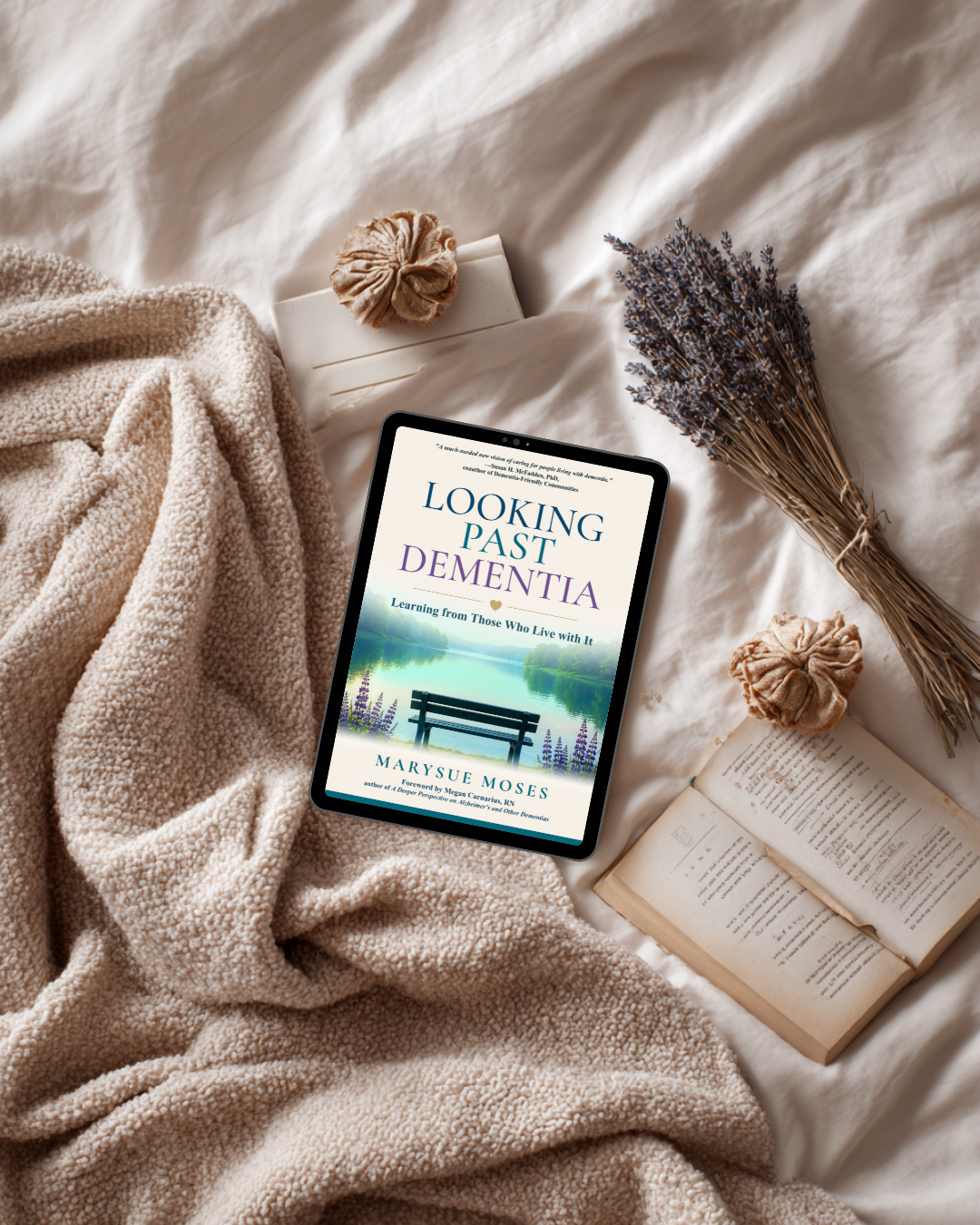
Marysue Moses’s
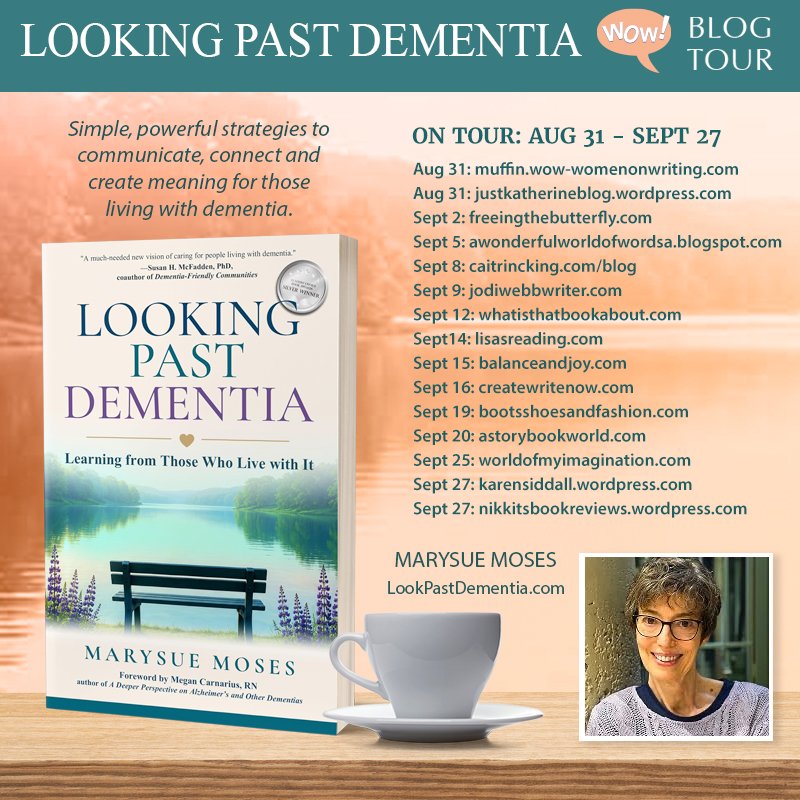
WOW! WOMEN ON WRITING TOUR
OF
Looking Past Dementia: Learning from Those Who Live with it
Tour Begins August 31
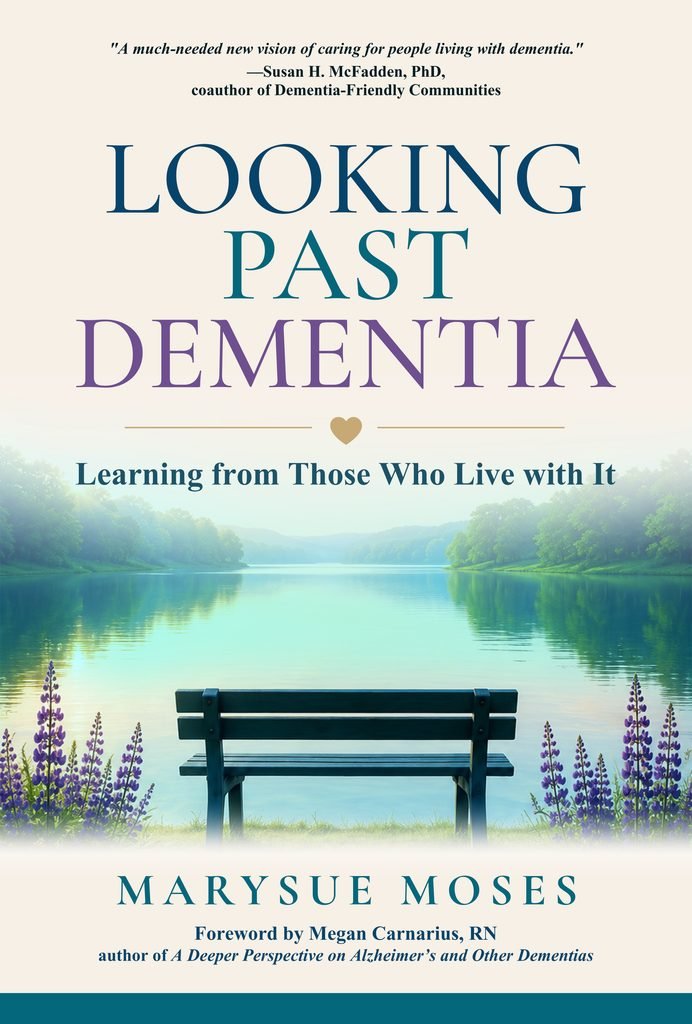
Book Summary
In Looking Past Dementia, dementia educator Marysue Moses shares the powerful insights she has gained from more than twenty years working alongside individuals living with Alzheimer’s disease and other forms of dementia.
Through deeply human stories, she challenges readers to look beyond symptoms and diagnoses to recognize the strengths, emotions and humanity that remain.
Publisher: Emerald Lake Books ISBN-10: 1945847964 ISBN-13: 978-1945847967 ASIN: B0HDS1FWBL
Print length: 202 Pages
Purchase a copy of Looking Past Dementia on Amazon. Add it to your GoodReads list.

About the Author Marysue Moses is a dementia educator, consultant and former memory care coordinator who teaches practical, creative approaches to dementia care. Drawing on both professional experience and her family’s journey with dementia, she helps caregivers foster meaningful connection and engagement.
You can follow the author at: https://lookpastdementia.com
https://www.facebook.com/profile.php?id=61590647100255
https://muffin.wow-womenonwriting.com
August 31 @ Just Katherine
Katherine shares excerpts from Looking Past Dementia: Learning from Those Who Live With It by Marysue Moses.
https://justkatherineblog.wordpress.com
September 2 @ Freeing the Butterfly
Stop by Michelle’s blog for her review of Looking Past Dementia: Learning from Those Who Live With It by Marysue Moses.
https://freeingthebutterfly.com/blog/news
September 5 @ A Wonderful World of Words
Stop by Joy’s blog for a guest post by Marysue Moses on good grief.
https://awonderfulworldofwordsa.blogspot.com
September 8 @ CC King’s blog
Join Caitrin’s blog for a guest post by Marysue Moses on how she found a Shakespeare quote for every chapter in her book.
https://www.caitrincking.com/blog
September 9 @ Words by Webb
Stop by Jodi’s blog for her review of Looking Past Dementia: Learning from Those Who Live With It by Marysue Moses.
https://www.jodiwebbwriter.com
September 12 @ What Is That Book About
Stop by Michelle’s blog for a spotlight of Looking Past Dementia: Learning from Those Who Live With It by Marysue Moses.
https://www.whatisthatbookabout.com
September 14 @ Lisa’s Reading
Stop by Lisa’s blog for an excerpt from Looking Past Dementia: Learning from Those Who Live With It by Marysue Moses.
September 15 @ Balance and Joy
Stop by Sheri’s blog for her review of Looking Past Dementia: Learning from Those Who Live With It by Marysue Moses.
September 16 @ Create Write Now
Stop by Mari’s blog for a spotlight of Looking Past Dementia: Learning from Those Who Live With It by Marysue Moses.
https://www.createwritenow.com/journal-writing-blog
September 19 @ Boots, Shoes and Fashion
Stop by Linda’s blog for an interview with Marysue Moses about her book Looking Past Dementia: Learning from Those Who Live With It.
https://bootsshoesandfashion.com
September 20 @ A Storybook World
Join Deirdre for a guest post by Marysue Moses on how her high school friends shaped her life.
https://www.astorybookworld.com
September 25 @ World of My Imagination
Stop by Nicole’s blog for her review of Looking Past Dementia: Learning from Those Who Live With It by Marysue Moses.
https://worldofmyimagination.com/my-blog
September 27 @ Boys’ Mom Reads
Stop by Karen’s blog for her review of Looking Past Dementia: Learning from Those Who Live With It by Marysue Moses.
https://karensiddall.wordpress.com
September 27 @ Nikki’s Book and Movie Reviews
Stop by Nikki’s blog for her review of Looking Past Dementia: Learning from Those Who Live With It by Marysue Moses.
https://nikkitsbookreviews.wordpress.com
EXCERPT
Mom’ s Journey Begins
What change is this?
—William Shakespeare, A Midsummer Night’s Dream, act 3
Margaret
Margaret awakens in the middle of the night, sits up straight, and stretches her
right arm into the darkness. Her hand is still unfamiliar with the pathway to the
switch on her new bedside lamp. After a bit of trail and error, she finds the base
and sighs in relief. Her fingers fumble for the… What’s that called, anyway? she
wonders. The thingy that you turn … Aha! She finds the knob and twists it.
Once her eyes adjust to the brightness, Margaret surveys her surroundings. She
feels out of place in the tiny apartment she moved into a few months ago. What am I
doing in this suffocating space? And where am I? She’s unsure of where she is.
Neural activity deep within her brain is trying to remind her she is in Denver,
Colorado, on the thirtieth floor of a senior high-rise, but she cannot decode that garbled
message.
Never mind that. The question is: where is my family? Though her son lives a few
miles away, and one of her four daughters is in Boulder, Margaret isn’t thinking about
them, and it’s not her late husband she’s missing now, either. She’s longing for her
father, mother and brothers. One thing feels certain: she needs to get home.
Margaret uses the bathroom, washes her hands and face, gets dressed, grabs her
purse, and finds the elevator. It’s a long ride down in that cold, metallic box. She is
grateful when the doors slide open at last. All is eerie―too quiet—but the gentleman
behind the front desk seems pleasant enough when he glances up from his book.
Though he appears surprised to see her, he gives Margaret a warm smile as she
approaches.
“Would you please call me a taxi?”
The man lifts his eyebrows and opens his lips, yet no words come out.
Margaret hastens to explain. “I need to go home … to Junction City, Kansas.”
Thankfully, the security guard was savvy enough to ensure Mom returned
to her apartment and my Colorado siblings were notified.
Learning about dementia began with my mother, Margaret.
Connecting First
Promise me friendship
—William Shakespeare, Timon of Athens, act 4
Mona
Mona is tall, gaunt, and miserable. I must say, she is the surliest resident of
our memory care community. Her usual mood is a blend of sour regret and
disgust. It’s rare to see family visit her. She is challenging to communicate with for
many team members, including me. Her favorite resident assistant, Becky, has earned
her trust, but others struggle to keep her on an even keel.
As the activities coordinator for memory care, I oversee snack time. Today, Mona
and Becky arrive early and take a seat. As I walk over to their table, I focus on
making my voice as sunny as possible: “Would you like coffee or lemonade?” Mona
shoots me a glare of disdainful irritation and responds to my overly sing- song approach
with three words: “Just. Say. Hi.”
Yikes. Did Mona ever put me in my rightful place! I was clueless about the
importance of the first few seconds of interaction when performing a task for a person
who is living with dementia. If we don’t connect first before diving into a chore, we have
a slim chance of building trust, the foundation of a good relationship, and we miss the
opportunity to make a meaningful, dramatic difference in that person’s experience.
Despite my embarrassment, I vowed to do better.
I take a breath. Lowering the tone of my voice to a more natural level, I sit down
at their table and say, “Hello, Mona. Hi, Becky.” We chat for a while before I
deliver their beverages and snacks.
Looking back, I regret not adding, “I’m glad you’re here.” I still had a lot to learn.
Even though I didn’t have the presence of mind to thank Mona for her reprimand, but
better late than never… Thank you, Mona, for reminding me to greet people by name,
shake their hands if that’s their preference, and do my best to make them feel welcome,
safe and seen before diving into my agenda.
Though Mona lived with dementia, she was perceptive enough to see that I had
not taken the time to see her. No wonder this aroused exasperation and anger. Maya
Angelou popularized the saying, “People will forget what you said, people will forget
what you did, but people will never forget how you made them feel.”5
I have found this
true of all human beings, including those who experience dementia. When interacting
with such individuals, considering how you want the person to feel is helpful.
Living with an Uncooperative Brain
How are our brains beguiled
—William Shakespeare, Sonnets, No. 59
Evelyn
“I feel like I have to meet the train, but I don’t know what the schedule is.” Out of
the blue, Evelyn confides this to me one day as we pass in the hallway. She
reminds me of a hothouse flower whose bloom will be destroyed if the
temperature, soundscape and humidity aren’t calibrated to perfection. On the
other side of her fragility, Evelyn is a trooper, a good sport with a healthy sense of
humor. Still, her sunny moods can flip over into nerves, morph into anxiety, and
escalate to full-fledged agitation.
Evelyn loves the color purple. Today, she sports purple pants, a long-sleeved
purple velveteen top, and her trademark grey felt hat.
Her tone is resigned yet frustrated when she refers to the train she feels she must
meet. Though she is well past the point of being aware of her Alzheimer’s
diagnosis, Evelyn is full of insight into what living with dementia is like. When
she mentions having to meet the train, her intended meaning hovers like a cloud
halfway between the literal and the symbolic. Part of her understands that she has
no train to catch; it’s something other than a train she’s missing. The other half
believes she needs to be somewhere she is not. If only she could recall what place
that is, how to get there, and where in the world she put the car keys.
Moreover, now that she thinks about it, she can’t for the life of her remember
where she parked…
Another day, after breakfast, Evelyn is having a tough morning. I’ve seldom seen
her struggle this much to put a sentence together. Unable to decipher her garbled speech,
I’m on the verge of taking her to see the nurse when the word bathroom emerges from
a sudden outpouring of nonsensical syllables. I offer to show her to the nearest
restroom down the hall. Evelyn nods and trudges along, chewing her bottom lip and
concentrating on maneuvering her walker. Her face contorts like a student trying to pick
the correct answer on an exam.
I hold the restroom door open and follow her in. Though she can manage on her
own in here, I stick around in case she needs extra help today. I lock the door and move
into a corner of the small bathroom. Evelyn stops short a few feet away from the toilet,
her gaze riveted on the bathroom floor.
Without looking my way, she proclaims, with surprising energy, “This floor! It
looks just like my brain.”
Her speech is clear as a bell. I inspect the floor to see what she might mean. It’s
covered with two-inch square, grayish-green tiles, and is dustier than one would prefer,
but apart from that there’s nothing of note. Every part of the floor looks like every
other part. Boring. No direction, nothing of interest. Dull, dull, dull.
Later that day, I returned to the bathroom. I couldn’t get Evelyn’s comment out of
my head. I took a photo of the floor and showed it to my husband, Phil, that evening. His
response was, “Huh. It’s like a crossword puzzle without any clues.”
What a valuable glimpse into the current backdrop of her mind, Evelyn had
offered that morning. Her remark taught me that we must work to transform what I
suspect many people living with dementia experience far too often: a landscape filled
with emptiness, suffused with boredom; a stage setting full of dead ends and roadblocks;
an overwhelming sense of dread, of being lost in a puzzle with no clue as to how to find
the way out. Doubtless, dementia mattered to Evelyn that morning―in a dark, dusty,
distressing way.
I realized I needed to stretch my understanding, to consider what reality feels like
for these individuals. It’s easy but unfair to blame them for being difficult and making our
jobs challenging to the point of discomfort. Isn’t their chore of dealing with an
uncooperative brain tougher than ours?
I learned from Evelyn and many others that there is a gift in accepting the
challenges that people living with dementia may present. A door swings open, inviting us
to explore, empathize, and understand that each individual is doing their absolute best
given the changes occurring in their brain. We begin to imagine what might be beneficial
for them. When our chosen strategy proves effective, we incorporate that tool into our
ever-evolving toolbox. Of course, not every tactic works for everyone all the time. That’s
why we need a substantial toolkit to handle the various situations and emotions that may
arise. We expand it and increase our confidence with each person we are privileged to
know, care for, and learn from.
The more I understood what dementia felt like for Evelyn, the easier it became to
build trust with her, empathize with her concerns, and ensure our interactions were
positive and helpful.
Smoothing the Way
How well my comfort is revived by this!
William Shakespeare, Romeo and Juliet, act 3
Janet
Janet reminds me a little of the cartoon character Olive Oyl. I’m not sure why.
Perhaps it’s her dark, calf-length skirts and her petite, slender frame. Her style is simple,
even though she spent years selling women’s clothing at a major downtown department
store.
Janet’s personality, however, is a sharp contrast to Popeye’s shrill, gangly
girlfriend. She is calm, loving, and agreeable. Whenever I smile and reach out my hand,
she takes it and comes along.
In the six or seven years I’ve worked with Janet, I’ve never known a family
member to visit her—until today. I have been informed that Janet’s daughter, son
and daughter-in-law are now waiting in the lobby, asking to see her. So I take her out
to join them.
Though Janet’s family members greet her with smiles and hugs, she appears
confused and overwhelmed.
Her son Tim has flown in from another state and hasn’t seen her for a long time.
“Hey, Mom, guess who I am?”
Janet says nothing.
He prods. “C’mon, Mom, which of your sons am I? You can do it.” As he speaks,
Tim reminds me of a high school soccer coach giving a pep talk.
I understand he intends to be helpful and is trying to encourage his mother to
remember, but this tactic is backfiring. Janet appears distraught as well as confused.
I lead them to the spacious living room where they can sit, visit, and, I hope, feel
more relaxed.
Janet’s response to her son’s questioning made me realize that our role—as a
relative, care partner, friend, visitor, resident assistant, or other team member—includes
smoothing the way for people living with dementia. We must ask ourselves how we can
make things easier for them. This doesn’t mean we should do things for these individuals
that they can do themselves. Rather, we should not expect their brains to accomplish
tasks they cannot manage, such as understanding logic, remembering previous
conversations, or…recalling our names. This task will prove even more difficult if we
have been out of sight for a while.
When we see someone using crutches due to a broken leg, are we upset that the
person is not meeting our expectation of walking without them? No, we have compassion
for those who need help walking, and we are happy to hold a door open to make things
easier for them. Why not extend the same consideration to individuals whose brains are
affected by dementia?
In an interview conducted by researcher Kim Eckart, University of Wisconsin
Anthropology Professor Janelle Taylor questions the value of worrying about whether a
person living with dementia still recognizes you. The more important question, Taylor
points out, is “Do you recognize them?”14 Meaning, I think, do you see them? Can you
connect with, support, honor and befriend who they are now?
The interaction between Janet and her relatives taught me that my job included
smoothing the way for family members to help them find ways to connect with their
loved ones. I could have met with the family first, without Janet, to learn how long it had
been since they last saw her. I might have mentioned she may not remember their names.
It would have been wise to point out that avoiding memory-related questions could ease
her anxiety. Instead, they could use statements to provide helpful answers. If her son had
said, “Mom, it’s me, your favorite son, Tim!” it would have spared Janet the stress of a
guessing game.
A fascinating insight from dementia specialist Megan Carnarius is that an
individual living with Alzheimer’s dementia who appears to have forgotten their loved
ones may still remember them. Carnarius points out that the damage in their brains can
prevent them from controlling their facial expressions and showing emotion in the
socially expected way.
15 For family members and friends of someone living with
dementia, this insight offers encouragement to keep visiting, connecting, and supporting
them as dementia progresses.
Engagement with Purpose
Here is the heart of my purpose
—William Shakespeare, The Merry Wives of Windsor, act 2
I well remember, long ago, walking into my bedroom to check on my
twelve-month-old daughter. Eliza had been crawling around and quiet for too long. I
discovered her ripping up the pages of a stack of picture books stored on an open bottom
shelf of a nightstand. Grinning from ear to ear, sitting amidst a messy pile of ripped-up
paper, Eliza was having a blast with her newfound activity and accomplishment.
Children are curious. Their brains are designed to pursue activities that interest
them, build motor skills, and offer a sense of achievement. People living with dementia
tend to lose skills in the opposite order that children gain them as they grow. Although
those who experience dementia are full-fledged adults, as the condition progresses, their
brains respond to their environment as though from an earlier developmental time. In her
book, A Deeper Perspective on Alzheimer’s and Other Dementias, Megan Carnarius
explores this progressive journey with profound insight and compassion.32
We need to stay aware that the minds of those living with dementia will seek out
ways to remain engaged and to experience the satisfaction of fulfilling a purpose. We
must also remember that we may or may not appreciate the plan those minds design.
Sometimes, people living with dementia channel their boredom, frustration, or
lack of engagement in far more challenging directions. Many of us who have worked in
memory care have encountered more than one person who packs up their belongings
again and again because they feel it is time to “go home.”
When Mom moved into her first memory care community, she was a regular
packer-upper, as she had gotten it into her head that she was about to be “thrown out.”
My brother thought it best to tell Mom about the impending move a few weeks
before the event, but this backfired. Her feeling of being thrown out of her current home
moved right along with Mom to her new place and stuck around for a while.
Over the years, I learned that in this situation, helping someone pack is often the
best way to “cross to the person’s side of the street.” Then, it’s easy to suggest taking a
break for lunch or an upcoming activity, while someone else on the team goes in and
unpacks when the packer is otherwise engaged. Away from their space, the person may
well forget about packing, at least for the day.
One time, a woman in our memory care called 911 for help because she felt
trapped and lonesome to the point that she didn’t know what else to do.
On several occasions, another woman pulled the fire alarm. Looking back, I
wonder if she acted out of desperation, panic, a desire for excitement, or a curiosity that
compelled her to follow the instructions on the handle, which, of course, said, “PULL.”
Regardless, it’s clear that a lack of meaningful activity influenced her choice of
engagement
Bill
When Bill first arrived at our memory care residence, I knew little about him, but
I soon learned he was handy with a screwdriver. He’d moved in with one in his
possession. Our team failed to notice this until Bill decided to put that tool to good
use.
In broad daylight, unbeknownst to anyone working on the second floor, Bill
disassembles and removes the mechanism that keeps the secure door locked and the
alarm functioning. Once he exits through the door and out into assisted living, it isn’t
long before he is intercepted and returned.
Our maintenance staff drag over a hefty bookcase to block the doorway, ensuring
Bill and other memory care community members remain safe and in place until the
alarm mechanism is repaired.
It’s fortunate that a second door escaped the wrath of Bill’s screwdriver, which,
alas for Bill, has now been confiscated.
Decades after Bill’s escape attempt, I am encouraged and excited by the growing
movement of senior communities in the US and beyond that have stopped locking the
doors that divide memory care residences from assisted living. Instead, they are
implementing new methods and technologies to ensure resident safety. In addition, more
sites have ended the practice of segregating those needed memory care from those who
don’t by providing services for those living with dementia throughout the broader
community. No doubt Bill would approve.
Appendix A. Strategies for Managing (or Reducing the Risk of)
Dementia
Many people ask whether there are ways to reduce the risk of dementia. While no
strategy can guarantee prevention, growing research indicates that certain lifestyle habits
support brain health and overall well-being. These activities enrich our lives regardless of
age or diagnosis by keeping us connected, engaged, active and emotionally supported.
Exercise. Exercise is at the top of the list for maintaining brain health. It is believed to
be the single best thing we can do for our brains. If you’re unsure about suitable activities
for you or your loved one, consult your doctor for guidance.
Focus on eating habits. A plant-centered, organic diet is not just a suggestion; it’s a
fundamental key to wellness. Ensure you drink enough water, limit sugar intake, and
include Omega 3-rich fats in your diet (found in nuts, seeds, and fatty fish like salmon,
Rainbow trout, and lake whitefish).
Reduce your stress. Devote plenty of time to things that help you relax and give you joy.
One possibility would be listening to your favorite music for thirty minutes daily.
Maintain a sense of purpose, meaning, and engagement. It’s important to stay
involved in tasks you love and to show your care for others. We all need opportunities to
make a difference.
Get 7-8 hours of sleep each night. This is vital for protecting brain health and managing
dementia. Avoid consuming caffeine in the afternoon or evening to improve your sleep
quality.
Learn new things. Complexity grows the brain. New interests can be developed, and
creative pursuits can be adapted to suit our abilities as we age.
Stay engaged. As social creatures, we need to interact and be in community with others
for our mental health as well as our brain health.
Humor is healing. We should do whatever we can to bring more humor into our lives. A
moment of laughter can reduce stress, lift spirits, and help people feel more connected to
one another.
The author gratefully acknowledges the Dementia Action Alliance, including Laurie
Scherrer, Janice Bays, and Casey Venturini, for their inspiration and guidance related
Views: 12
Subscribe for the Bonus Words and Latest Book Reviews!
One reply on “Looking Past Dementia: Learning from Those Who Live with it”
Thank you, Lisa, for promoting my book on your site! Much appreciated!